From Bowie Bonds to Blackstone: The Deals That Turned Music Into an Asset Class
When Sony agreed to pay roughly $4 billion for a portfolio of song catalogs in 2026, the music industry barely blinked. Forty years ago, the idea that recorded songs were a serious financial asset — something pension funds would own and rating agencies would grade — sounded absurd. The story of how that changed is really the story of about a dozen deals. If you invest in music royalties, even from $10, these deals set the prices you pay and the market you'll one day sell into. Here's the history worth knowing.
The short answer
Music became an asset class through three waves of deals. First, a visionary bet: Michael Jackson buying the Beatles' publishing in 1985 — arguably the single best music investment ever made. Second, a financial invention: the 1997 "Bowie Bonds," which proved royalties could back Wall Street securities. Third, the modern gold rush: from 2018 onward, superstar catalogs sold for hundreds of millions, and then the world's largest private equity firms — Blackstone, Apollo, KKR — moved in with billions.
Each wave did the same thing: it put a public, verifiable price on future royalty income. That pricing history is why a retail investor today can look at a catalog's cash flow and know roughly what it's worth. The market didn't always have that. Someone had to build it, one landmark deal at a time.
1985: The bet that started everything
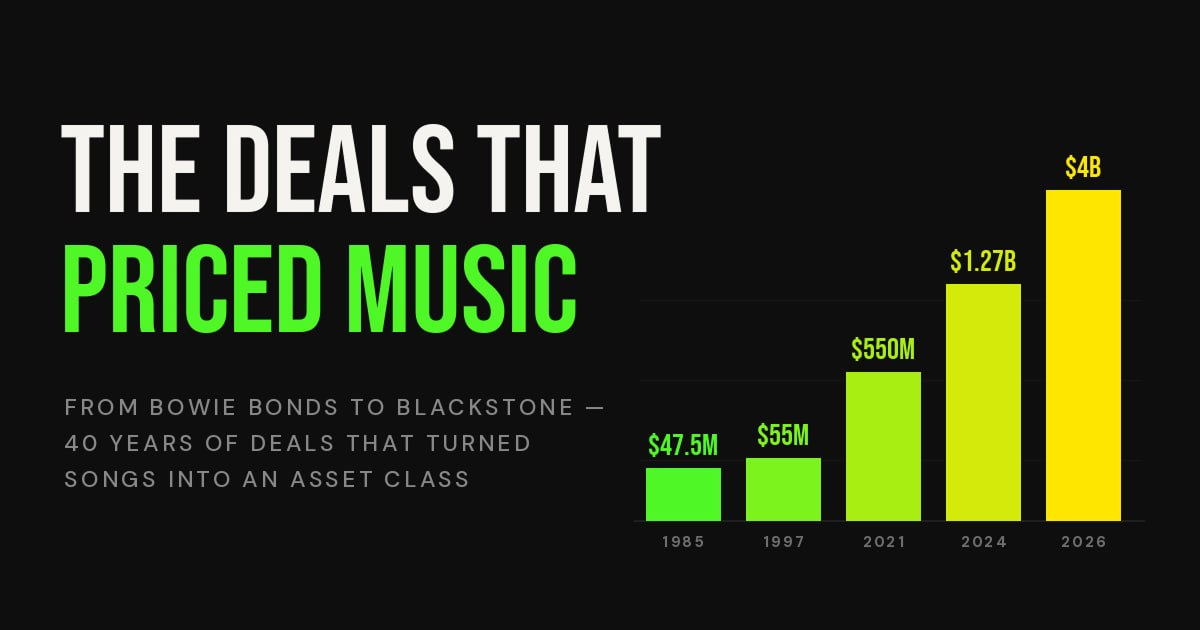
In 1985, Michael Jackson paid $47.5 million for ATV Music — a publishing catalog whose crown jewels were about 250 Lennon–McCartney songs. Industry insiders thought he overpaid. Paul McCartney, who had personally told Jackson that song rights were the smartest thing to own, was famously unhappy to be outbid on his own catalog.
The "overpayment" became legend. A decade later, Jackson merged ATV with Sony's publishing arm in a deal that valued his stake at roughly double what he paid. By 2016, Sony bought out the Jackson estate's half of Sony/ATV for $750 million — valuing the combined company at $1.5 billion. And in 2024, Sony went further, acquiring half of the estate's remaining music assets at a valuation reported north of $1.2 billion — the largest valuation ever attached to a single artist's body of work.
One catalog. Four decades. Roughly a 25x return before counting the royalty income it generated every single year along the way. Every catalog buyer since has been chasing the same math.
1997: Bowie Bonds — royalties meet Wall Street
In 1997, David Bowie did something no musician had done: he securitized himself. Working with banker David Pullman, Bowie sold $55 million of bonds backed by the future royalties of 25 albums recorded before 1990. Prudential Insurance bought the entire issue. Moody's gave it an investment-grade rating — the same scale used for corporate debt.
The deal mattered less for its size than for its precedent. For the first time, a rating agency formally assessed the predictability of song royalties, and an institutional investor treated them as fixed-income collateral. The structure had rough years — Napster-era piracy crushed music sales, and the bonds were downgraded in 2004 before paying out as scheduled — but the template survived.
That template is now a market. Music royalty securitizations are rated by Moody's, S&P and Fitch as a matter of routine, and in 2025 alone, over $4.4 billion of music-backed bonds were issued — bought by insurers, pension funds and asset managers. Every one of those deals is a descendant of Bowie's $55 million experiment.
2018–2023: The superstar gold rush
Three forces collided at the end of the 2010s: streaming made royalty income predictable, interest rates near zero made steady yield precious, and a new buyer — Hipgnosis Songs Fund, which IPO'd on the London Stock Exchange in 2018 — was willing to pay aggressively and publicly. The result was the biggest repricing in music history.
The scoreboard from those five years:
- Bob Dylan sold his songwriting catalog to Universal in December 2020 for a reported $300–400 million — then sold his recorded music to Sony about a year later.
- Bruce Springsteen topped it in December 2021, selling both his publishing and recordings to Sony for a reported ~$550 million — at the time, the biggest single-artist transaction ever.
- Sting sold to Universal for a reported ~$300 million (2022). Genesis and Phil Collins sold to Concord for a similar figure. David Bowie's estate sold his songwriting to Warner Chappell for ~$250 million.
- Justin Bieber, at 28, sold his catalog rights to Hipgnosis Songs Capital for ~$200 million (2023) — proof the market wasn't just for legacy acts.
- Queen reset the ceiling in 2024: Sony acquired the band's catalog and related rights for a reported ~$1.27 billion — the largest single-catalog deal in history. Pink Floyd followed at ~$400 million for their recorded music.
Why did the artists sell? Mostly rational finance: a lump sum taxed as capital gains versus decades of uncertain income taxed as ordinary income, estate planning for aging catalogs, and sale multiples that had never been higher. The sellers weren't naive — they were reading the same market the buyers were.
2021–2026: The institutions arrive
The superstar deals made headlines. The quieter, more important story was who started funding them.
In 2021, Blackstone — the world's largest alternative asset manager — committed roughly $1 billion alongside Hipgnosis Song Management to buy catalogs, and KKR partnered with Dundee Partners to acquire a $1.1 billion music rights portfolio from Kobalt. In 2022, Apollo backed Concord's $1.8 billion music royalty securitization — at the time the largest music ABS ever — and Francisco Partners acquired Kobalt itself in a deal reported around $750 million.
Then came consolidation. In 2024, Blackstone took the publicly listed Hipgnosis fund private at a $1.6 billion equity value, ending a turbulent chapter for the pioneer of listed song funds. In February 2026, Universal closed its $775 million acquisition of Downtown Music, bringing CD Baby, FUGA and Songtrust under major-label control. And in May 2026, Sony agreed to acquire Recognition Music Group — the entire ex-Hipgnosis portfolio — from Blackstone for a reported ~$4 billion, the largest catalog transaction ever announced.
Read that sequence again as an investor: the world's most sophisticated buyers of cash flow spent five years building positions in music royalties, and the world's biggest music companies are now paying billions to buy those positions out. Assets don't get that treatment unless the income underneath them is real.
A 2026 postscript: Katy Perry, TikTok, and why buyers keep paying
If you want a single fresh example of why sophisticated money pays nine figures for song catalogs, it happened this summer.
In September 2023, Katy Perry sold her stake in the master royalty income and publishing rights across five albums — including Teenage Dream — to Litmus Music, a company backed by private equity giant Carlyle, in a deal reported at ~$225 million. Skeptics called it another peak-market splurge on a legacy pop catalog.
Then, in September 2026, TikTok named "The One That Got Away" — a 15-year-old single from that very catalog — its Global Song of the Summer, as catalog tracks swept the entire US Top 4 on the platform. A song released in 2011 out-streamed the new releases of 2026. Every one of those billions of plays generates royalty income — and that income now flows to the catalog's owner, not to Perry.
Two takeaways, one for each side of the market. For investors: great songs don't just hold value — they can spike years later, and the revival upside belongs to whoever owns the income stream. For artists: selling a catalog outright means selling both the upside and the control. That's exactly why partial monetization models — selling a share of royalty income while keeping ownership of the music, the way artists do on Ripe — exist in the first place.
What three decades of deals did to prices
Landmark deals don't just make news — they set benchmarks. In the mid-2010s, a solid catalog might sell for 8–12x its annual net royalty income. At the peak of the gold rush, blue-chip superstar catalogs commanded 25–30x. When interest rates rose in 2022–2023, discipline returned: multiples for ordinary catalogs settled meaningfully lower, while the truly iconic ones (Queen, Pink Floyd) kept setting records.
Two lessons hide in that history. First, price discipline matters — buyers who paid peak multiples for average catalogs in 2021 have had a humbling few years. Second, the market now has tiers: superstar catalogs trade like trophy real estate, while the vast middle of the market — working catalogs with steady streams — trades at far more grounded multiples. That middle tier is where most retail-accessible platforms, including Ripe, actually operate.
Why this history matters for a $10 investor
Every deal in this article happened between institutions, superstars and billion-dollar funds. Retail investors watched from outside. That's precisely the access gap the current generation of platforms exists to close — and the deal history is what makes closing it possible:
- Validation. You're not early to an unproven idea. Blackstone, Apollo, KKR, Sony and Universal have collectively priced this asset class with tens of billions of dollars. The question "is royalty income real?" was settled by people who don't gamble.
- Benchmarks. Because these deals are public, catalog valuation is no longer folklore. Streaming data plus established multiples means a fairly priced catalog is a knowable thing — whether it costs $400 million or $40.
- An exit environment. Majors and funds paying billions for royalty portfolios means the assets you hold fractions of exist inside a deep, liquid institutional market — not a niche curiosity.
The irony of the last 40 years: music royalties became institutional-grade before they became accessible. The deals built the market. Platforms like Ripe are just handing out the keys — from $10, with payouts every Friday.
FAQ
What's the biggest music catalog deal in history?
By portfolio: Sony's ~$4 billion agreement to acquire Recognition Music Group (the ex-Hipgnosis catalogs) from Blackstone, announced in May 2026. By single catalog: Queen's ~$1.27 billion sale to Sony in 2024. By single-artist valuation: the Michael Jackson estate transaction with Sony in 2024, which implied a value north of $1.2 billion.
Why do successful artists sell their catalogs at all?
Tax efficiency (one capital-gains event versus decades of ordinary income), estate simplicity (cash divides more easily than song rights), risk transfer (a lump sum today versus uncertain streaming economics tomorrow), and — bluntly — because multiples reached levels too attractive to refuse. Selling is usually a financial decision, not a creative surrender.
Do billion-dollar deals mean small investors are overpaying?
No — they operate in a different tier. Superstar catalogs carry trophy premiums the way penthouse apartments do. The catalogs accessible to retail investors are priced off their actual streaming cash flow at far more modest multiples. If anything, the mega-deals help small investors: they anchor the valuation methods, the rating frameworks and the exit demand for the entire asset class.
Could this all reverse?
Deal volume is cyclical — it slowed when rates rose in 2022–2023 and reaccelerated as they eased. But the structural shift looks permanent: rating agencies grade music debt, insurers hold it, and the majors treat catalogs as core strategic assets. Markets that build this much infrastructure rarely un-build it.
Investing involves risk, including possible loss of principal. This article is for informational purposes only and does not constitute investment advice. Past deal prices are not indicative of future catalog values.